 |
| NEW YORK -- Sgt. Mohamed Mohamed, a New York native and personnel chief, 1st Marine Recruiting District, stands with the The National Museum of the Marine Corps Traveling Exhibit in Federal Hall. The exhibit contains a collection of paintings by Marines and is part of Fleet Week New York 2011. It is open from 9 a.m. to 5 p.m May 24 - 27, May 31 and June 1. More than 3,000 Marines, Sailors and Coast Guardsmen will be in the area participating in community outreach events and equipment demonstrations. This is the 27th year New York has hosted the sea services for Fleet Week. For more information on Fleet Week New York 2011 visit www.fleetweeknewyork.com. (Official Marine Corps HDR image by Sgt. Jimmy Shea / RELEASED) |
'Ode to Joy'

May 25, 2011
Photo of the Day


May 23, 2011
Marines dedicate Afghanistan compound to fallen lieutenant colonel
 |
| Marines bow their heads in prayer during a dedication ceremony at the Marine Air Control Group 28 compound at Camp Leatherneck, Afghanistan, May 21. The ceremony was held in honor of Lt. Col. Benjamin Chili Palmer, the former commanding officer of 2nd Low Altitude Air Defense Battalion, who was killed in action in Helmand province, Afghanistan, May 12. (Photo by Cpl. Rashaun X. James) |
CAMP LEATHERNECK, Afghanistan — Deployed Marines and sailors honored the life and service of former 2nd Low Altitude Air Defense Battalion commanding officer, Lt. Col. Benjamin J. Palmer, by dedicating to him the Marine Air Control Group 28 compound on Camp Leatherneck, Afghanistan, May 21.
“Marines, this is not a day of sadness,” said Lt. Col. Thomas P. Bajus serves as the MACG-28 detachment commander in Afghanistan. “We should remember Lt. Col. Palmer as a hero who gave his life for us.”
Palmer served with 2nd LAAD Bn., part of MACG-28, through December 2010, at Marine Corps Air Station Cherry Point, N.C.
Bajus and Palmer served together with the group – Palmer as the commanding officer 2nd LAAD Bn., and Bajus as the commanding officer of Marine Tactical Air Control Squadron 28.
“Today was not a memorial ceremony, but rather a dedication ceremony to remember a fallen hero,” said Bajus. “We have chosen to name our compound after Lt. Col. Palmer, one of our own.”
Palmer deployed to southwestern Afghanistan with II Marine Expeditionary Force (Forward) in April and was killed while working with a mentoring team that provides support to the Afghan National Civil Order Police in Helmand province, May 12.
“What he has left us all is the passion he had in being a Marine,” Bajus said.
The control group’s compound will now be known as “Chili’s Corner,” in honor of Palmer’s call sign. A sign at the entrance to the compound also states that it is dedicated in the memory of the fallen Modesto, Calif., native.
“Marines like Lt. Col. Palmer are the reason why we will not be defeated here,” Bajus said. “We all look after our own, just like he did.”
“You don’t realize how much someone means to you until they’re gone,” said 1st Lt. Joel R. Searls, a close battle coordinator with MTACS-28. “I worked for Lt. Col. Palmer at 2nd LAAD as a platoon commander, adjutant, safety officer and battery executive officer. He was my battalion commanding officer and he was very down-to-earth. You could talk to him about any problem that you had.”
Palmer’s personal decorations included the Defense Meritorious Service Medal, Meritorious Service Medal, Republic of Korea Joint Service Commendation Medal, Navy and Marine Corps Commendation Medal with two gold stars and the Navy and Marine Corps Achievement Medal with gold star. Palmer is survived by his wife and four children.
Photo of the Day
 |
| Commandant of the Marine Corps Gen. James Amos gives his remarks during the Home of the Commandants ribbon cutting ceremony at Marine Barracks Washington May 20. Amos and his wife invited local neighbors to visit the inside of the renovated home. The consturction on the house has been ongoing since Amos's change of command ceremony in October 2010. (Photo by Sgt. Bobby J. Yarbrough) |
May 20, 2011
Marines hone marksmanship, tactics during Dynamic Assault
 |
| A Marine from Force Reconnaissance Platoon, Force Company, 31st Marine Expeditionary Unit, III Marine Expeditionary Force, fires at targets May 10 during the Dynamic Assault Course at Camp Hansen's Range 16. (Photo by Lance Cpl. Anthony Ward Jr) |
CAMP HANSEN, Okinawa, Japan — Reconnaissance Marines are conducting marksmanship training drills as part of the Dynamic Assault Course taught by the Special Operations Training Group on Camp Hansen’s Range 16 April 25 to May 27.
The Marines, with Force Reconnaissance Platoon, Force Company, 31st Marine Expeditionary Unit, III Marine Expeditionary Force, are participating in this training in preparation for an upcoming deployment.
The Dynamic Assault Course is a five-week course, with the first two weeks focusing on marksmanship, said Staff Sgt. Jason Adkins, the lead instructor for the course. The next three weeks focus on tactics, where the students learn insertion, breaching objectives with explosives, and the proper techniques used to secure an objective.
Dynamic Assault Course instructors are all reconnaissance Marines from SOTG, III MEF Headquarters Group, III MEF.
This class is important as it pushes a force reconnaissance platoon’s skills to a high level and provides the Marines with the required certification to be part of a force reconnaissance platoon, Adkins said. With the training, the platoon can be employed by its commander to carry out direct-action missions, he added.
During the first week of training, Marines fired the M1911 .45 caliber pistol and M4A1 service rifle while training at ranges simulating different urban environments.
“(The training) is very important for the type of mission(s) we do,” said Staff Sgt. Lin Barrios, assistant platoon sergeant for the platoon.
As part of the MEU, the Marines need to know how to operate in different environments, said Barrios.
After familiarizing themselves with their weapons and zeroing in their aiming points, the Marines moved to live-fire shooting in a close-quarters situation.
“I like all the tactics,” said Cpl. Angel Robles, a reconnaissance Marine with the 31st MEU and a student in the course. “There’s all kinds of stuff going through your head. (When entering a room), you have to remember if you’re one man, two man or rear security.”
In close quarters situations, teams of four to six Marines enter a room using proper room-clearing techniques, identify the threats and use the proper method to take them down.
You have to have a certain mindset for it, said Barrios.
“(There’s) a thousand ways you can take over a house, and there’s a thousand ways to mess it up. At this level, you have to be in the correct mindset to do the job.
“Most of the Marines are responding very well to (the training),” added Barrios. “It’s very important to throw them in this kind of environment early.”
The Marines, with Force Reconnaissance Platoon, Force Company, 31st Marine Expeditionary Unit, III Marine Expeditionary Force, are participating in this training in preparation for an upcoming deployment.
The Dynamic Assault Course is a five-week course, with the first two weeks focusing on marksmanship, said Staff Sgt. Jason Adkins, the lead instructor for the course. The next three weeks focus on tactics, where the students learn insertion, breaching objectives with explosives, and the proper techniques used to secure an objective.
Dynamic Assault Course instructors are all reconnaissance Marines from SOTG, III MEF Headquarters Group, III MEF.
This class is important as it pushes a force reconnaissance platoon’s skills to a high level and provides the Marines with the required certification to be part of a force reconnaissance platoon, Adkins said. With the training, the platoon can be employed by its commander to carry out direct-action missions, he added.
During the first week of training, Marines fired the M1911 .45 caliber pistol and M4A1 service rifle while training at ranges simulating different urban environments.
“(The training) is very important for the type of mission(s) we do,” said Staff Sgt. Lin Barrios, assistant platoon sergeant for the platoon.
As part of the MEU, the Marines need to know how to operate in different environments, said Barrios.
After familiarizing themselves with their weapons and zeroing in their aiming points, the Marines moved to live-fire shooting in a close-quarters situation.
“I like all the tactics,” said Cpl. Angel Robles, a reconnaissance Marine with the 31st MEU and a student in the course. “There’s all kinds of stuff going through your head. (When entering a room), you have to remember if you’re one man, two man or rear security.”
In close quarters situations, teams of four to six Marines enter a room using proper room-clearing techniques, identify the threats and use the proper method to take them down.
You have to have a certain mindset for it, said Barrios.
“(There’s) a thousand ways you can take over a house, and there’s a thousand ways to mess it up. At this level, you have to be in the correct mindset to do the job.
“Most of the Marines are responding very well to (the training),” added Barrios. “It’s very important to throw them in this kind of environment early.”
Photo of the Day
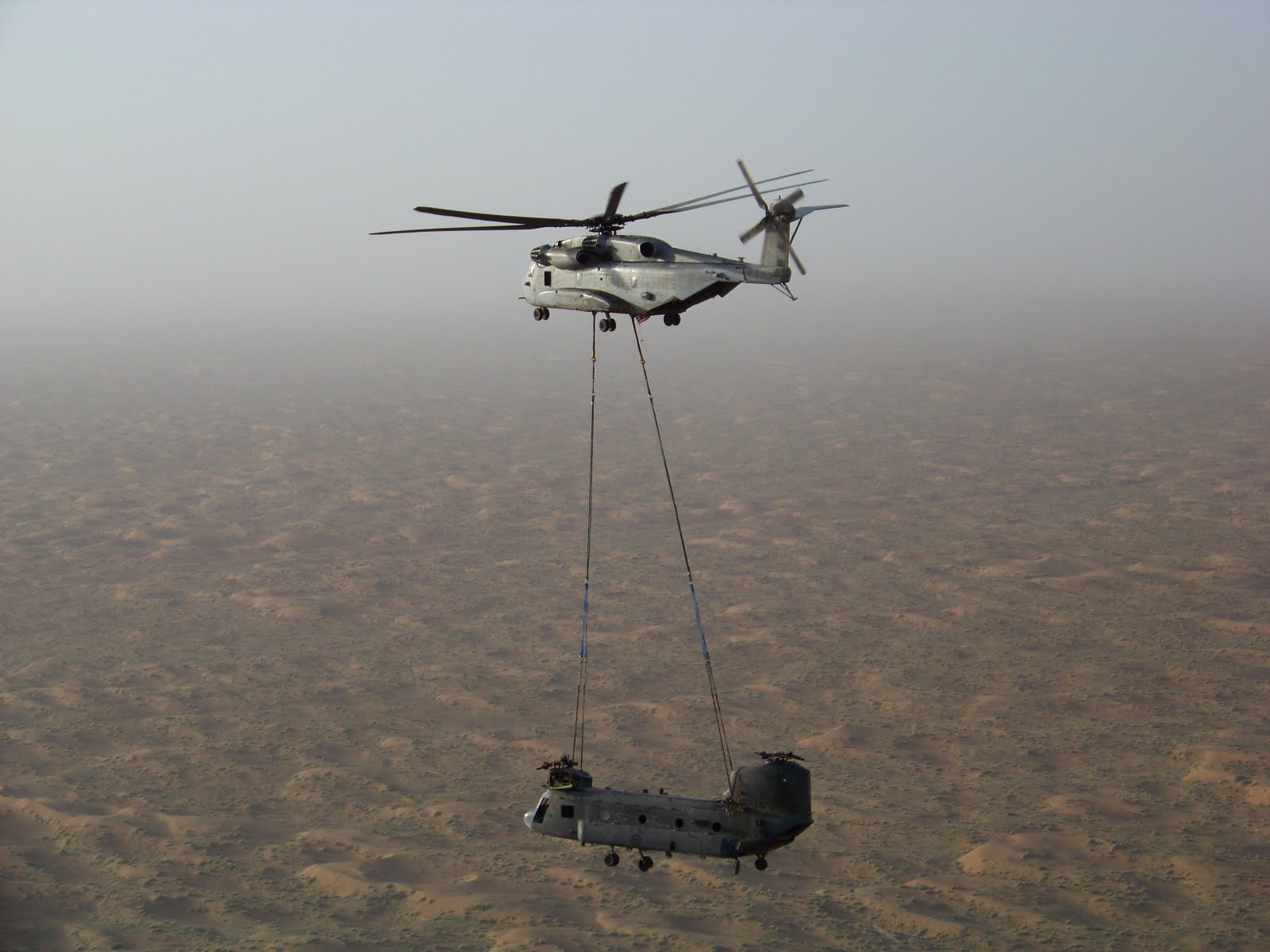 |
| A Marine Heavy Helicopter Squadron 461 CH-53E Super Stallion transports a Canadian Forces CH-47 Chinook during a tactical recovery of aircraft and personnel mission in Kandahar Province, Afghanistan, May 17. Utilizing a trio CH-53E Super Stallion helicopters from Marine Heavy Helicopter Squadron 461, with assistance from 2nd Marine Logistics Group's helicopter support team, the Canadian and American team was able to transport the injured aircraft back to its home at Kandahar Airfield, Afghanistan. (Photo by Sgt. Thomas W. Dowd) |
May 19, 2011
Photo of the Day
 |
| Lance Cpl. Marcus Terry fires the M-249 Squad Automatic Weapon through a mock window on an unknown distance course at Marine Corps Base Quantico, Va., May 18. Terry is an infantryman assigned to the Ground Comabt Element, Marine Barracks Washington. (Photo by Sgt. Bobby J. Yarbrough) |
Marines shut down Army in sitting volleyball
 |
| The Marines took down the All-Air Force sitting volleyball team in a victories best-of-three series during the Warrior Games May 18, 2011, at the Olympic Training Center in Colorado Springs, Colo. Commandant of the Marine Corps Gen. James F. Amos and Sergeant Major of the Marine Corps Sgt. Maj. Carlton Kent surprised the Marines when they arrived to cheer on the team. |
COLORADO SPRINGS, Colo. — The All-Marine sitting volleyball team squashed the hype from the Army during their first matchup May 17 during the 2011 Warrior Games at the Olympic Training Center in Colorado Springs, Colo.
The Marines won in a best-of-three game series that marked the first faceoff of the sitting volleyball round robin event.
The hype and rivalry began at the Inaugural Warrior Games in May 2010 when the Marines beat the Army in the final sitting volleyball game, culminating last year’s Warrior Games.
This year, the rivalry continued with some friendly exchanges of smack-talk between Marines and Soldiers during the game – some talk coming from the day of the Warrior Games’ opening ceremony.
The All-Army team took the lead in the best-of-three set when they beat the Marines 27-25 in the first game.
As the Army celebrated their sting ecstatically, the Marines regrouped with some helping words from head coach Brent Peterson.
“You talk about teamwork, you talk about camaraderie, you talk about the will – it’s all right here in this game,” Peterson said. “We’ve trained for this since February. Whoever wants the win will take it.”
The Marines retorted to the Army’s first win with a solid 25-16 victory in the second game, and a 15-10 victory for the tie-breaker and overall game win.
Lance Cpl. Joshua Wege was a proud volleyball victor. He said the game was a makeup for the loss he and the All-Marine wheelchair basketball team took just earlier in the evening. Wege and several Marines served as vital players in both games.
“It feels great to throw one back at [the Army],” said Lance Cpl. Jese Schag, an animated force in sitting volleyball and wheelchair basketball. “They were a solid team. The win feels great and I’m pumped to keep going.”
Just like the wheelchair basketball event, teams play four matches operating in a round-robin format. Teams will then be seeded to play for bronze and gold medals.
The Marines took on the Special Operations Command team right after defeating the Army, and won in stride in just two matches. The Marines are scheduled to take on the Air Force team May 18 and the Navy/Coast Guard team May 19 in sitting volleyball.
Marine veteran Cpl. Savage Margaf of the sitting volleyball team said there’s a lot of excitement in this event, and they’re going to continue playing their game for the remainder of the Warrior Games.
“There’s no holding back – no mercy,” she said.
The Marines won in a best-of-three game series that marked the first faceoff of the sitting volleyball round robin event.
The hype and rivalry began at the Inaugural Warrior Games in May 2010 when the Marines beat the Army in the final sitting volleyball game, culminating last year’s Warrior Games.
This year, the rivalry continued with some friendly exchanges of smack-talk between Marines and Soldiers during the game – some talk coming from the day of the Warrior Games’ opening ceremony.
The All-Army team took the lead in the best-of-three set when they beat the Marines 27-25 in the first game.
As the Army celebrated their sting ecstatically, the Marines regrouped with some helping words from head coach Brent Peterson.
“You talk about teamwork, you talk about camaraderie, you talk about the will – it’s all right here in this game,” Peterson said. “We’ve trained for this since February. Whoever wants the win will take it.”
The Marines retorted to the Army’s first win with a solid 25-16 victory in the second game, and a 15-10 victory for the tie-breaker and overall game win.
Lance Cpl. Joshua Wege was a proud volleyball victor. He said the game was a makeup for the loss he and the All-Marine wheelchair basketball team took just earlier in the evening. Wege and several Marines served as vital players in both games.
“It feels great to throw one back at [the Army],” said Lance Cpl. Jese Schag, an animated force in sitting volleyball and wheelchair basketball. “They were a solid team. The win feels great and I’m pumped to keep going.”
Just like the wheelchair basketball event, teams play four matches operating in a round-robin format. Teams will then be seeded to play for bronze and gold medals.
The Marines took on the Special Operations Command team right after defeating the Army, and won in stride in just two matches. The Marines are scheduled to take on the Air Force team May 18 and the Navy/Coast Guard team May 19 in sitting volleyball.
Marine veteran Cpl. Savage Margaf of the sitting volleyball team said there’s a lot of excitement in this event, and they’re going to continue playing their game for the remainder of the Warrior Games.
“There’s no holding back – no mercy,” she said.
May 18, 2011
Photo of the Day
 |
| 1st Lt. Christopher Campagna, commanding officer of 4th Assault Amphibian Battalion attachment, Landing Force CARAT, signals other Amphibious Assault Vehicles May 17 during a dry run of the final training exercise (FTX) in Thailand during Cooperation Afloat Readiness and Training 2011. CARAT is an annual bilateral exercise held between the U.S. and Southeast Asia nations with the goals of enhancing regional cooperation, promoting mutual trust and understanding, and increasing operational readiness. U.S. and Thai militaries are using AAVs, Marines and Sailors for the beach assault on May 18. The majority of the U.S. Marines participating in CARAT are reserve Marines who volunteered for the training. The U.S. Marine Corps Reserve is an integral element of the Marine Corps Operating Forces and shares the expeditionary mindset that encompasses the Marines’ culture. (Official Marine Corps Photo by Cpl. Aaron Hostutler) |
Marines ready to defend sitting volleyball title at Warrior Games
 |
| The All-Marine sitting volleyball team are ready to defend their title in their first game against the All-Army team at the 2011 Warrior Games May 17, 2011. Last year, the Marines said they devastated the All-Army team beating them twice in series of three games. The Warrior Games is an annual Paralympics sporting event for wounded, ill and injured service members. Last year, the Marines took the Chairman's Cup and are ready to defend their title. (Photo by Sgt. Michael Cifuentes) |
Story by Sgt. Michael Cifuentes
COLORADO SPRINGS, Colo. — At the 2010 Inaugural Warrior Games, the All-Marine team took home the Chairman’s Cup, including 19 gold medals, 24 silver and 16 bronze.
This year, it has already been known – all other services are looking to snatch the championship right back from the Marines.
Friendly, inter-service rivalry talk has been established leading up to the opening ceremony. Some athletes remember the stiff competition last year, and one event stands out: sitting volleyball.
The Marines said they “devastated” the All-Army team at the 2010 Warrior Games.
“We brought it last year, and there was a lot of smack-talking,” said veteran Marine Richard Bacchus of the sitting volleyball team, remembering the intense final game against the Army. “It was crazy.”
At the 2010 Warrior Games, the Marines beat the Army twice in a best of three series. Bacchus said Army seemed sure of a victory when they voiced their confidence.
“They were yapping how about how they were going to take us,” Bacchus said. “All we could do was look and smile when we were making plays. A lot of services are gunning for us, but I’d say the Army’s our main rivals in [sitting] volleyball.”
Last year, the Marines manned their sitting volleyball team by quick fills – anyone who was interested in competing in the sitting volleyball event was on the team. This year, through the success of recruiting wounded warriors and competition at the Marine Corps Trials, the Marines were able to select the best participants in the sport.
“Our team has grown to be more athletic and just better all around this year,” said veteran Marine Cpl. Travis Greene of the sitting volleyball team. “Our practices have been more intense, efficient and harder. We’re ready to go out there and show everyone what we got.”
Greene continued to say the rivalry with the Army has been around for centuries “outdating the Yankees and Red Sox rivalry.” But there’s no hatred between the services – just competition, and that’s all free game, he added.
The All-Marine sitting volleyball team is slated to take on the All-Army team May 17.
“It’s going to be a great game to watch,” said Lance Cpl. Jese Schag of the sitting volleyball team. “There’s going to be some serious competition. But we’re going out there to have fun.”
This year, it has already been known – all other services are looking to snatch the championship right back from the Marines.
Friendly, inter-service rivalry talk has been established leading up to the opening ceremony. Some athletes remember the stiff competition last year, and one event stands out: sitting volleyball.
The Marines said they “devastated” the All-Army team at the 2010 Warrior Games.
“We brought it last year, and there was a lot of smack-talking,” said veteran Marine Richard Bacchus of the sitting volleyball team, remembering the intense final game against the Army. “It was crazy.”
At the 2010 Warrior Games, the Marines beat the Army twice in a best of three series. Bacchus said Army seemed sure of a victory when they voiced their confidence.
“They were yapping how about how they were going to take us,” Bacchus said. “All we could do was look and smile when we were making plays. A lot of services are gunning for us, but I’d say the Army’s our main rivals in [sitting] volleyball.”
Last year, the Marines manned their sitting volleyball team by quick fills – anyone who was interested in competing in the sitting volleyball event was on the team. This year, through the success of recruiting wounded warriors and competition at the Marine Corps Trials, the Marines were able to select the best participants in the sport.
“Our team has grown to be more athletic and just better all around this year,” said veteran Marine Cpl. Travis Greene of the sitting volleyball team. “Our practices have been more intense, efficient and harder. We’re ready to go out there and show everyone what we got.”
Greene continued to say the rivalry with the Army has been around for centuries “outdating the Yankees and Red Sox rivalry.” But there’s no hatred between the services – just competition, and that’s all free game, he added.
The All-Marine sitting volleyball team is slated to take on the All-Army team May 17.
“It’s going to be a great game to watch,” said Lance Cpl. Jese Schag of the sitting volleyball team. “There’s going to be some serious competition. But we’re going out there to have fun.”
May 17, 2011
Photo of the Day
 |
| Cpl. Oscar Franquez, rifle inspector with the United States Marine Silent Drill Platoon, looks over his Marines during the Friday Evening Parade at Marine Barracks Washington May 13. (Photo by Sgt. Bobby J. Yarbrough) |
Subscribe to:
Posts (Atom)